How a Media Buying Team Got Rid of Spreadsheet Chaos — the 100FTD Case
When a media buying company is still small, you can get away with running the numbers manually. But once the number of projects, budgets and traffic sources starts growing, finance quickly gets scattered across dozens of Google Sheets and Excel files. At that point, getting a real P&L and cash flow picture on the fly becomes a challenge. And without clean numbers available whenever you need them, decisions take longer — especially when it comes to scaling.
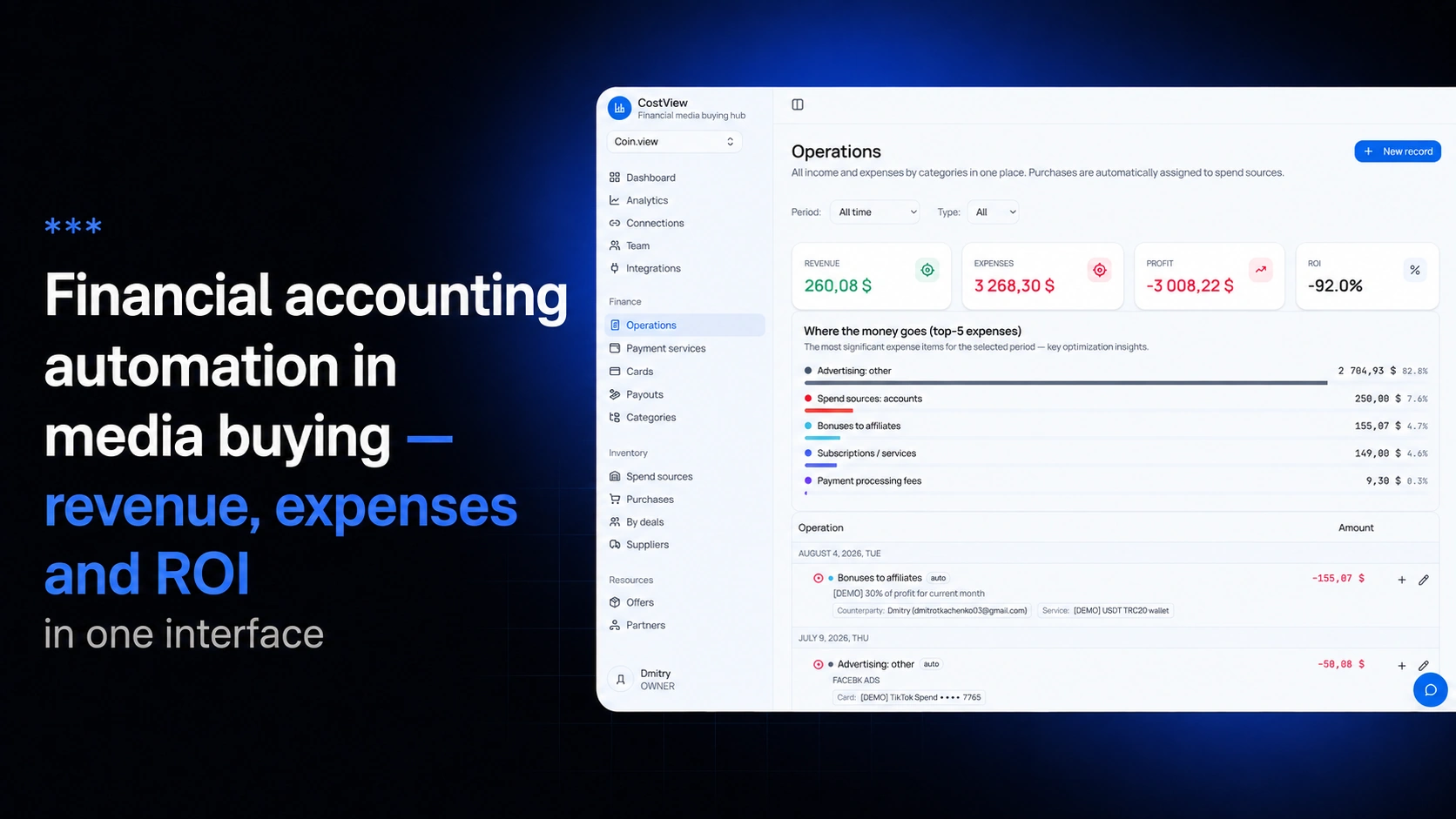
That is exactly why the CostView team built a financial control system that lets media buying companies manage cash flow with the level of visibility you would normally expect from a full-scale finance team. The 100FTD case shows how it works in practice.
Financial accounting automation as an edge in media buying
100FTD is a media buying team with more than eight years of experience in iGaming traffic and affiliate marketing. The team is large, the projects operate at scale and the buyers know their stuff, but as the operation grew, 100FTD ran into a problem most scaling media buying teams eventually face — financial management. When formulas start breaking across dozens of sheets and the numbers no longer match, the setup has to change.
The biggest pain point was discrepancies between reports and the amount of time being burned on manual reporting. 100FTD runs a lot of processes in parallel: multiple projects, traffic sources, teams and advertising models. The media buying team could see the numbers for an individual campaign, but there was no fast, complete view of the operation as a whole — how much the traffic was actually making, what each buyer was bringing in and where profit was leaking.
“Our expenses were sitting in one set of spreadsheets, campaign results in another, while payouts and extra costs were tracked separately. We had to manually pull everything into one master sheet just to see the full picture. Eventually, Excel turned into a mess: formulas kept breaking, numbers stopped matching, and reporting was taking more and more time. Most importantly, we had no quick and clear way to see how the business was actually performing,”
CostView suggested moving the entire financial workflow into one system instead of maintaining a stack of spreadsheets. Rather than manually building a master sheet, the team could automatically calculate P&L, cash flow and profit for every offer and every buyer from one interface. That meant discrepancies could be spotted straight away instead of being discovered at the end of the month, when figuring out where they came from becomes a separate headache.
Buyer payouts, trackers and the full picture for every offer
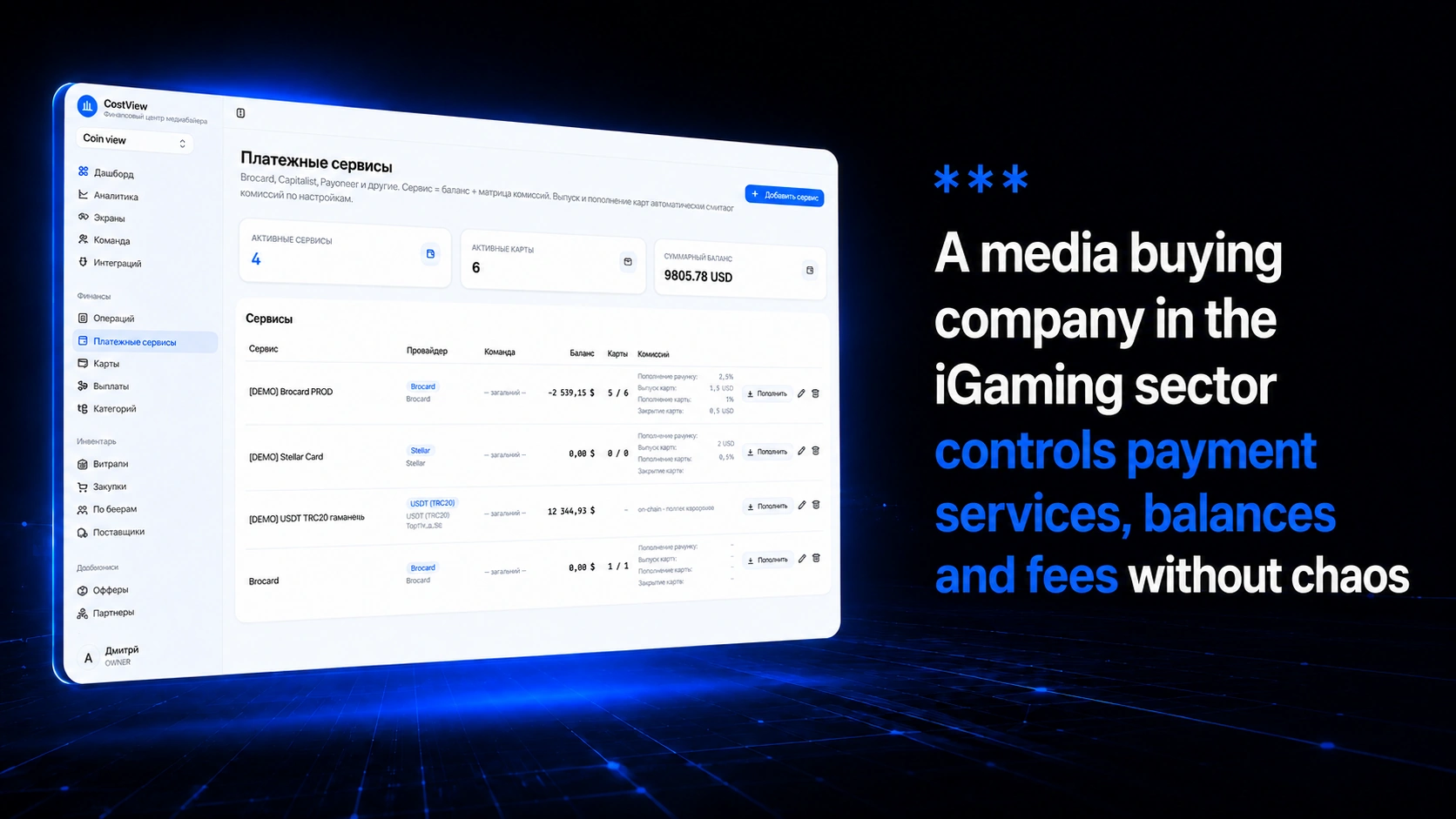
CostView automates one of the trickiest parts of financial ops for a media buying team — buyer payouts based on different comp models — while also connecting trackers and payment systems. The platform brings together ROI for each campaign setup, revenue and traffic costs by buyer, actual cost, the status of operational assets such as accounts, cards and fan pages, and other financial events in one place.
CostView is available in two setups: Cloud — for teams that want to get up and running quickly without maintaining their own infrastructure, and Self-Hosted — for teams where financial data privacy is critical and the data must physically stay inside the client’s own infrastructure.
“I started out in traffic arbitrage on the technical side and eventually worked my way up to CTO of a large affiliate group. Along the way, I worked with all kinds of teams — from small media buying units to major holdings. Everywhere I looked, financial accounting was living across dozens of Google Sheets and Excel files. That created chaos and made it almost impossible to quickly calculate the team’s real profit, P&L and cash flow. As a result, earnings in media buying became much harder to predict.
That constant pain around financial tracking was what triggered the idea for CostView. We wanted to build a system where the numbers are calculated automatically, finance is properly structured, and founders, team leads and finance people can finally see the real picture of profit, expenses and cash flow in one place,”
After implementing CostView, the 100FTD team started keeping its financial data in one system. The team can now see expenses, profit and cash flow faster and make decisions based on up-to-date numbers rather than manually assembled reports.
This case is a good example of what it means to make money in media buying systematically instead of simply winging it. In a market where a few percentage points can make or break the margin, proper financial control becomes a real competitive edge for any media buying company working in iGaming or other affiliate verticals.
We also covered the case in more detail in an interview for Traffic Ultras.